Hotel direct booking statistics for 2026, direct vs OTA in numbers
Direct channels still bring in 51.3% of hotel overnights in Europe, but OTAs have grown for a decade. Here are the 2026 numbers on shares, cancellations, booking value and what an OTA booking costs.
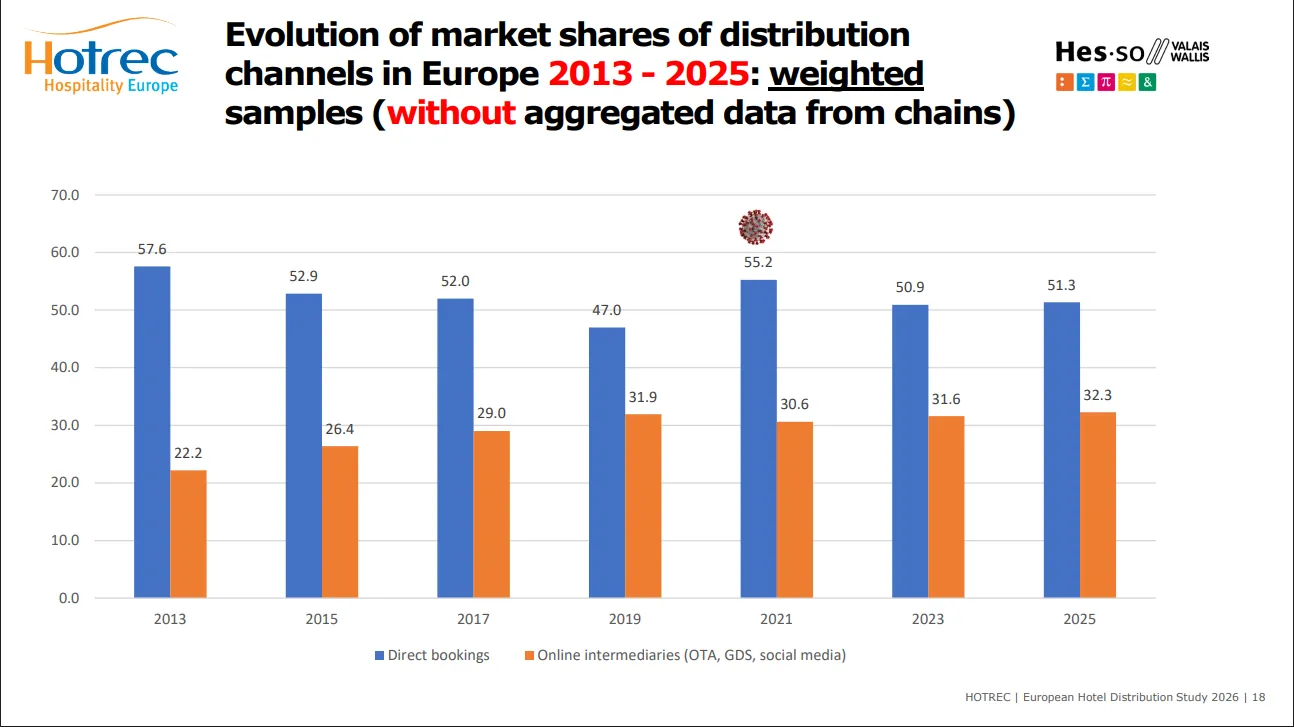
Direct booking still brings in the largest share of hotel stays in Europe: 51.3% of overnights in 2025, against 29.9% for OTAs, according to HOTREC's survey of 2,713 hotels. The direct share has slipped from 57.6% in 2013, while online intermediaries grew from 22.2% to 32.3%.
Most public numbers on hotel distribution come from Europe, because HOTREC runs the only large survey of hotels that repeats every two years. The United States has no public equivalent, so for the US we rely on the filings of Booking Holdings and Expedia Group and on platform data from SiteMinder. Every figure below names its source and the sample behind it.
Key figures 2026
These are the numbers to know before deciding how hard to push direct booking. All were checked on November 1, 2026 against the original document.
| Indicator | Value | Scope | Period | Source |
|---|---|---|---|---|
| Direct share of overnights | 51.3% (57.6% in 2013) | European hotels, weighted, without chain data | 2025 | HOTREC 2026, p. 4 and 18 |
| OTA share of overnights | 29.9% | Same | 2025 | HOTREC, September 2026 |
| Online intermediaries (OTA, GDS, social media) | 32.3% (22.2% in 2013) | Same | 2025 | HOTREC 2026, p. 4 |
| Booking Holdings, share of OTA bookings | 68.8% | 1,591 European hotels reporting their OTA mix | 2025 | HOTREC 2026, p. 92 |
| Expedia Group, share of OTA bookings | 16.6% (12.5% in 2021) | Same | 2025 | HOTREC 2026, p. 6 |
| Cancellation rate, own website / Booking.com / Expedia | 9.1% / 19.0% / 11.7% | European hotels, unweighted | 2025 | HOTREC 2026, p. 110 |
| Average booking value, hotel website / OTA | US$516 / US$312 | Bookings on the SiteMinder platform | 2025 | SiteMinder |
| Booking Holdings room nights | 325 million, up 5% | All brands, worldwide | Q2 2026 | Booking Holdings |
| Booking Holdings marketing expense | 4.7% of gross bookings | All brands, worldwide | Q2 2026 | Booking Holdings |
| Expedia Group booked room nights | 111.5 million, up 6% | Worldwide | Q2 2026 | Expedia Group |
| Hotels using an OTA payment service | 65% | European hotels, unweighted | 2025 | HOTREC 2026, p. 121 |
What share of hotel bookings is direct in 2026?
About half. Direct channels produced 51.3% of hotel overnights in Europe in 2025, a share that has moved between 47% and 58% since 2013.
Direct channels generated 51.3% of overnights at European hotels in 2025, according to the European Hotel Distribution Study 2026 published in September 2026 by HOTREC and HES-SO Valais-Wallis (weighted estimates without chain data, based on 2,713 hotels). The series starts at 57.6% in 2013, falls to 47.0% in 2019, peaks at 55.2% in the pandemic year 2021 and has stayed close to 51% since. Online intermediaries, meaning OTAs, the GDS and social media, went the other way, from 22.2% in 2013 to 32.3% in 2025. OTAs alone account for 29.9%, against 29.6% in 2023 in the same table, so roughly stable. HOTREC's own reading is that distribution remains direct-led but that OTAs have become an unavoidable part of the mix, especially for large, urban and international hotels. For an independent hotel, that means the question is rarely direct or OTA, but how much of each.
Which channels count as direct?
Direct means any booking where the guest deals with the hotel without an intermediary, online or offline. Most of it is still offline.
In HOTREC's 2025 weighted estimates, phone brought in 14.1% of overnights, email 13.5% and real-time bookings on the hotel's own website 13.9%. Contact forms without live availability added 5.2%, walk-ins 3.0% and mail or fax 1.6% (HOTREC 2026, p. 16 and 17). So the booking engine, the channel most hotels mean when they talk about direct booking, carries just over a quarter of the direct total (13.9 of 51.3 points).
How much of the OTA channel do Booking and Expedia control?
Most of it. Booking Holdings and Expedia Group together took 85.4% of OTA bookings at European hotels in 2025.
Among the 1,591 hotels that reported their OTA mix to HOTREC, Booking Holdings had 68.8% of OTA bookings and Booking.com alone 66.1%. Expedia Group had 16.6%, up from 12.5% in 2021, and no other OTA group reached 4% (HOTREC 2026, p. 6 and 92). Expedia does better with large, upscale, urban and business hotels. In the data from ten European hotel chains, it holds around one third of OTA bookings, and the two groups together reach almost 94%.
Dependence varies a lot from one hotel to the next. The average OTA share in the unweighted sample is 27.8%, but nearly one quarter of hotels get less than 10% of their room nights from OTAs, while around one third get 30% or more (HOTREC 2026, p. 90).
The scale of the two platforms explains the pull. Booking Holdings sold 325 million room nights in the second quarter of 2026, up 5% on a year earlier, on US$51.0 billion of gross bookings (Booking Holdings, August 4, 2026). Expedia Group booked 111.5 million room nights in the same quarter, against 105.5 million a year earlier (Expedia Group, August 5, 2026).
Which hotels get the most direct bookings?
Small independent hotels outside big cities. Size and location move the direct share far more than any single tactic.
| Segment (HOTREC 2026, p. 84) | Direct share 2025 |
|---|---|
| Rural region | 64.8% |
| Alpine or mountain region | 64.5% |
| City under 10,000 inhabitants | 62.1% |
| Hotel under 20 rooms | 59.1% |
| Independent hotel | 55.2% |
| 5-star hotel | 45.9% |
| Urban area | 45.8% |
| Hotel of 100 rooms or more | 45.1% |
| Chain hotel | 42.7% |
| City over 250,000 inhabitants | 36.1% |
Countries differ just as much. Italy (64.0%) and Finland (62.7%) had the highest direct shares, while Hungary (39.8%) and Spain (35.2%) had the highest OTA shares (HOTREC 2026, p. 4 and 22).
Chains follow another model. Ten European hotel chains managing 831 hotels and 128,154 rooms got 29.4% of their overnights from OTAs, 11.2% from the GDS, 20.1% from their websites and 17.5% by phone in 2025 (HOTREC 2026, p. 20). The GDS share reflects corporate travel, which independent leisure hotels rarely see.
Are direct bookings worth more than OTA bookings?
On the available data, yes. Direct bookings are worth more per stay, and guests cancel them less often.
SiteMinder, whose platform generates over 140 million hotel bookings a year, found that bookings made on hotel websites were worth US$516 on average in 2025, against US$445 for wholesalers, US$392 for the GDS and US$312 for OTAs (SiteMinder, Hotel Booking Trends). That puts the average direct booking 65.4% above the average OTA booking, a calculation from SiteMinder's two figures ((516 minus 312) divided by 312). SiteMinder sells a channel manager and a booking engine, so this is platform data, not a market survey, and an average booking value mixes length of stay, room type and price. D-EDGE, another technology vendor, reports the same pattern on its panel of more than 5,000 French hotels: direct bookings were made 47 days ahead on average in 2025, against 35 days on Booking.com and 31 on Expedia (D-EDGE, March 2026).
Cancellations widen the gap. European hotels told HOTREC that, on average, 19.0% of their Booking.com bookings were cancelled in 2025, against 11.7% of Expedia bookings and 9.1% of bookings made on their own website.
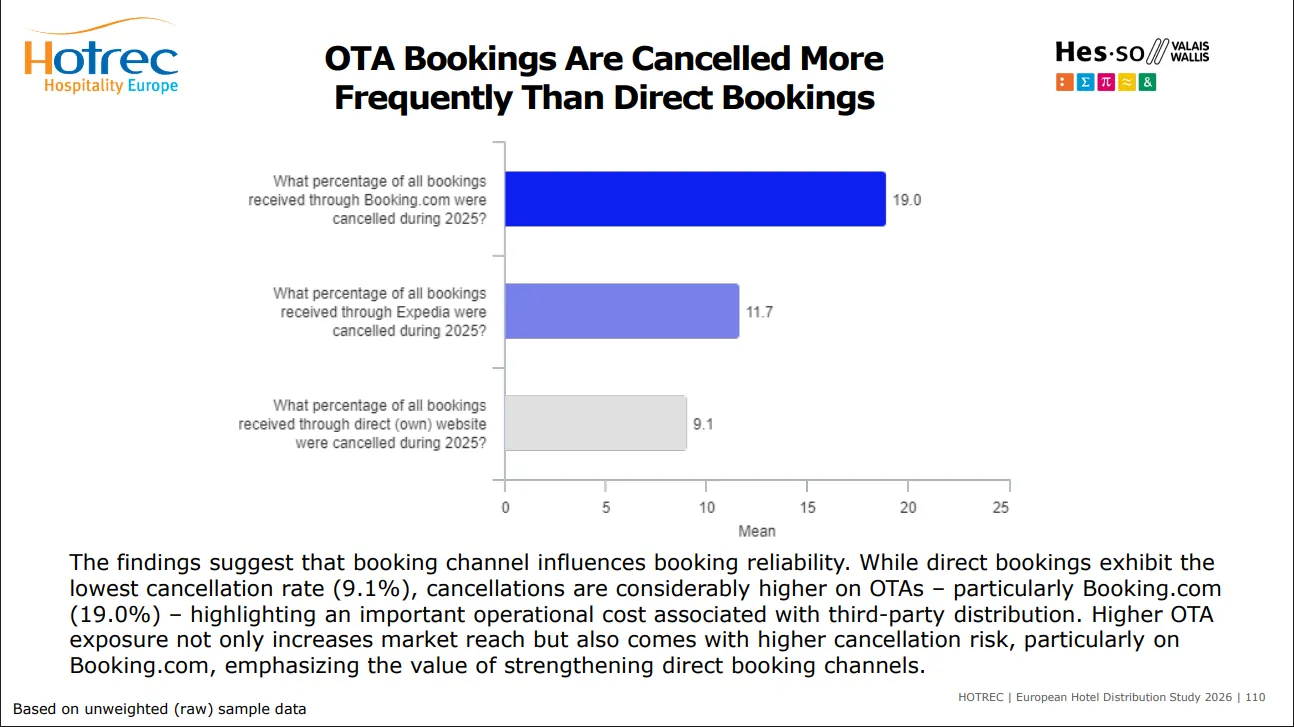
The D-EDGE figures for France point the same way. Its panel's overall cancellation rate fell from 24.6% to 22.6% in 2025, yet close to 44% of the revenue booked through Booking.com was cancelled. HOTREC adds that large urban chain hotels with advanced online distribution report the highest cancellation rates on all three channels, so a big city hotel should expect more than these averages.
How much does an OTA booking cost a hotel?
Nobody can give one rate, because Booking.com and Expedia do not publish a standard commission. What is public is how the commission works and how much the platforms keep overall.
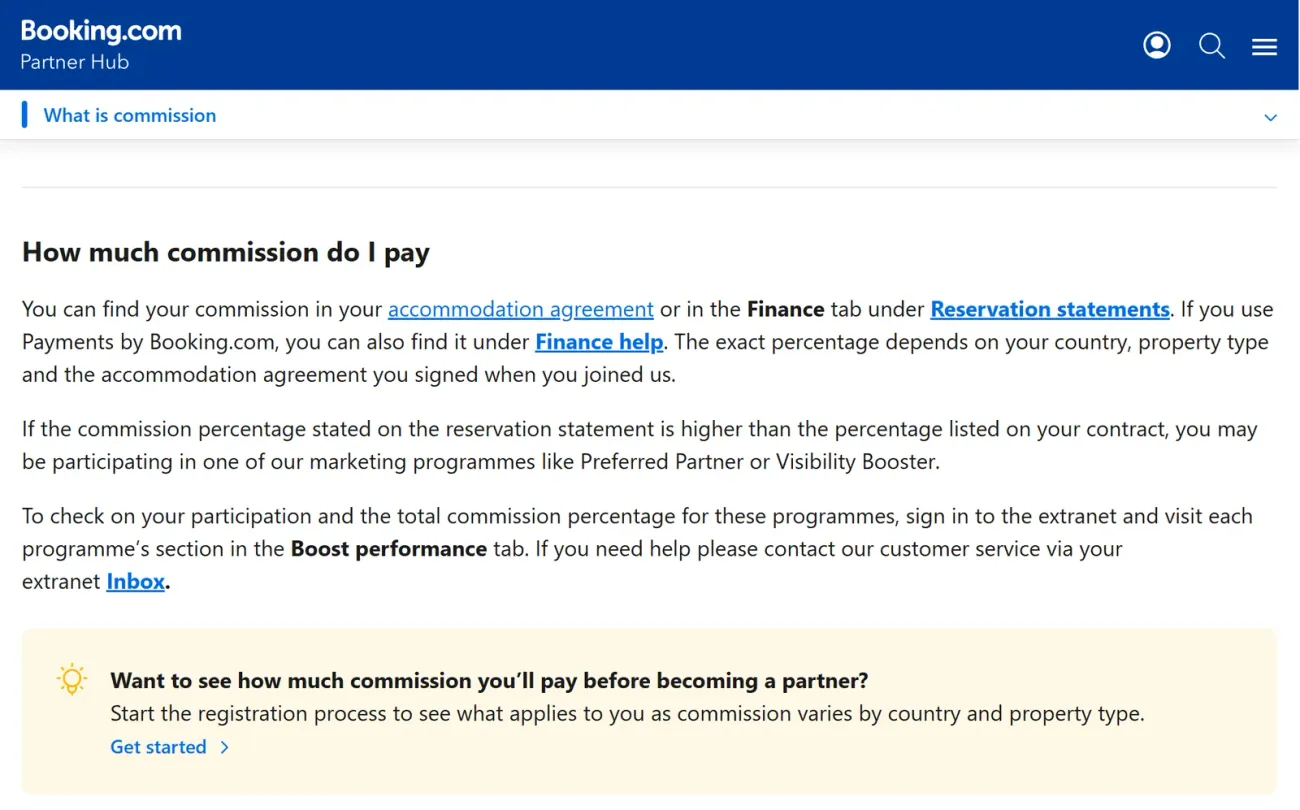
Booking.com's partner help page says that "the exact percentage depends on your country, property type and the accommodation agreement you signed", and that programmes such as Preferred Partner or Visibility Booster add to it (Booking.com for Partners). Commission is charged once the guest checks out, on the room rate plus extra fees such as cleaning, and also on non-refundable bookings and charged no-shows. In most countries it also applies to VAT, but not to local taxes such as city tax.
Group accounts give an order of magnitude. Expedia Group's lodging revenue was US$3,429 million in the second quarter of 2026 on US$24,603 million of lodging gross bookings, so lodging revenue equalled 13.9% of lodging gross bookings in that quarter (calculation from the Expedia Group release). Revenue is mostly counted at the stay and gross bookings at the booking, so the ratio moves from quarter to quarter (10.0% in the first quarter of 2026). It mixes agency commissions and merchant margins, and it is not a commission rate any single hotel pays.
Here is how to price your own exposure with the rate in your contract:
- Take your annual rooms revenue, for example €800,000.
- Multiply by your OTA share. At the European average of 29.9%, that is €239,200 of OTA revenue.
- Each point of commission on that revenue costs €2,392 a year.
- Moving 5 points of share from OTAs to direct shifts €40,000 of revenue onto channels with no commission, minus what you spend on your booking engine and marketing.
The platforms pay to win that traffic too. Booking Holdings spent US$2,371 million on marketing in the second quarter of 2026, 4.7% of its gross bookings, and said that over the trailing four quarters a mid-fifties percentage of its room nights came through its direct channel, meaning travelers who go straight to its apps and websites (Booking Holdings release). Hotels and OTAs are chasing the same habit: the guest who goes straight to them.
Why do sources disagree on the direct share?
Because they measure different things. A survey of hotels counts every booking, while vendor data only sees online bookings that pass through its own systems.
HOTREC, the European hotel trade association, asks hotels for their full channel mix, phone and email included. In its European Hotel Distribution Study 2026, it found for 81 French hotels a 56.2% direct share in 2025 and 25.5% for OTAs (HOTREC 2026, p. 60). D-EDGE reads confirmed bookings from more than 5,000 French hotels connected to its platform and reports that OTAs make up about 70% of volume, with direct at about 25% of volume and 33% of value. Both can be right. D-EDGE's direct figure comes from bookings that go through its platform, in practice the hotel's booking engine, while phone, email and walk-ins, which HOTREC counts, never reach its system. A French hotelier who reads both reports in the same week can therefore see a direct share of 56% and of 25% for the same year. Compare yourself with the source that measures what you measure.
How are AI assistants and Google changing direct booking?
AI is changing where travelers start, more than where they book. Google's new booking flow sends the sale to a hotel or a platform, and both OTAs and chains signed up first.
Google started rolling out hotel booking in AI Mode in the United States in English on August 27, 2026, with Booking.com, Expedia, Hotels.com, Priceline, Trip.com, Choice Hotels, Hilton, IHG, Marriott and Wyndham as partners. The traveler pays with Google Pay, and the hotel or booking platform acts as merchant of record (Google, August 27, 2026). Independent hotels are not on that list yet. Their route to the same screens is metasearch: 58% of European hotels have a permanent interface with a metasearch engine, and 83% of those use Google Hotel Ads, while only 26% of hotels use AI at all (HOTREC 2026, p. 4).
If assistants such as ChatGPT or Gemini never name your hotel, direct demand shrinks before your booking engine can convert it. Our comparison of GEO tools for hotels covers the software that measures this.
How can a hotel increase its direct booking share?
Start with the channels that already bring direct business, then make the booking engine as easy as the OTA. The figures above point to six practical steps.
- Answer the phone and email fast. Together they brought 27.6% of European overnights in 2025 (14.1% plus 13.5%), about twice the booking engine's share.
- Check parity every week. HOTREC found that 51% of hotels saw OTAs undercut their rates at least occasionally in 2025, which sends guests away from your website.
- Connect your rates to Google Hotel Ads through your booking engine or channel manager, so the direct price shows next to the OTA offers.
- Give a reason to book direct that is not a discount: breakfast, flexible cancellation or a room upgrade.
- Use the OTA guest's stay to win the next booking direct, with a clear website address and a returning-guest offer.
- Track net revenue by channel. Our RevPAR guide explains net RevPAR, which subtracts distribution costs before comparing.
A channel manager keeps rates aligned across sites while you shift the mix, which removes most of the overbooking risk.
What to do with these numbers
Pull your own channel report for 2025 and set it against the segment table above. If you run a small independent hotel and your direct share sits well under 55%, start with the phone, the email inbox and parity before paying for new tools.
Frequently asked questions
What percentage of hotel bookings are direct?
In Europe, direct channels produced 51.3% of hotel overnights in 2025, according to the HOTREC European Hotel Distribution Study 2026. That figure covers phone, email, walk-ins, contact forms and the hotel's own booking engine. Online platform data such as D-EDGE's counts only bookings that pass through its systems and shows a much lower direct share.
Is it cheaper to book a hotel directly?
Often the room price is the same, because many hotels keep the same public rate on every channel. The difference sits on the hotel's side: a direct booking carries no OTA commission, so the hotel keeps more of the price and can offer a perk such as breakfast or a later checkout instead of a discount. Check the cancellation terms, which differ by channel.
What is the market share of Booking.com in Europe?
Booking.com alone took 66.1% of OTA bookings at European hotels in 2025, and Booking Holdings as a group 68.8%, according to HOTREC (1,591 hotels reporting their OTA mix). That is a share of OTA bookings, not of all bookings. OTAs as a whole made up 29.9% of overnights.
Do OTA bookings cancel more than direct bookings?
Yes, in the 2025 HOTREC data. Hotels reported that 19.0% of their Booking.com bookings and 11.7% of their Expedia bookings were cancelled on average, against 9.1% of bookings made on their own website. Large urban chain hotels with advanced online distribution report the highest rates on every channel.
Which hotels get the most direct bookings?
Small independent hotels in small towns, rural areas and the mountains. HOTREC measured a 64.8% direct share for rural hotels and 64.5% in alpine regions in 2025, against 36.1% for hotels in cities of more than 250,000 people. Independent hotels averaged 55.2% direct, chain hotels 42.7%.
Will AI assistants replace OTAs for hotel bookings?
Not yet on the figures available. Google started rolling out hotel booking inside AI Mode in the United States in August 2026, and Booking.com and Expedia are among its first partners next to chains such as Marriott and Hilton. AI changes where the search starts, but the booking still goes to a hotel or a platform acting as merchant of record.
Sources
- HOTREC, Booking Holdings and Expedia Group account for 85% of Europe's OTA market (September 15, 2026)
- HOTREC and HES-SO Valais-Wallis, European Hotel Distribution Study 2026, results for the reference year 2025 (September 2026)
- Booking Holdings, second quarter 2026 financial results, exhibit 99.1 (August 4, 2026)
- Expedia Group, second quarter 2026 results, exhibit 99.1 (August 5, 2026)
- SiteMinder, Hotel Booking Trends 2026 (updated March 2026)
- D-EDGE, 2026 hotel distribution report for France, press release (March 24, 2026)
- Booking.com for Partners, Understanding your commission
- Google, 3 new ways to plan and book travel in Search (August 27, 2026)