Hotel ADR explained, the formula and 2026 benchmarks by segment and city
ADR is rooms revenue divided by rooms sold. This guide gives the formula and sourced 2025 and 2026 ADR figures for US and French hotels, by segment, by Hilton brand, by region and by city.

Hotel ADR, the average daily rate, is the average price a hotel earned for each room it sold. You get it by dividing rooms revenue by the number of rooms sold. US hotels averaged $160.54 in 2025, according to CoStar, and French hotels €133, according to In Extenso.
This guide gives the formula, worked examples, and sourced 2025 and 2026 ADR figures by hotel segment, region and city, so you can place your own rate.
What is ADR in a hotel?
ADR is rooms revenue divided by the number of rooms sold in the same period. It tells you the average price guests paid for the rooms that were occupied, and nothing about the rooms that stayed empty.
Hilton's third quarter 2026 results show the definition in use. The company defines ADR as hotel room revenue divided by room nights sold, and reported a system-wide ADR of $164.57 for the three months ended September 30, 2026, on occupancy of 75.8% and a RevPAR of $124.70 (Hilton, exhibit 99.1, October 27, 2026). Multiply the first two numbers and you get $124.74, which matches the reported RevPAR once rounding is taken out. That check works for any hotel and is the quickest way to catch a data error.
You will also see it called average rate or average room rate. All three mean the same thing.
Key figures 2026
| Indicator | Value | Scope | Period | Source |
|---|---|---|---|---|
| ADR | $160.54 (+0.9%) | United States, all hotels | 2025 | CoStar |
| ADR | $161.78 (+1.5%) | United States, all hotels | August 2026 | CoStar |
| ADR | $333.71 (+4.7%) | New York City | 2025 | CoStar |
| ADR | €133 (+1%) | France, all hotels | 2025 | In Extenso, via TourMaG |
| ADR | €126.9 (+0.2%) | France, all hotels, excl. VAT | 2025 | MKG, via CBRE |
| ADR | €239 (-1%) | Paris, all hotels | 2025 | In Extenso, via TourMaG |
| ADR | $164.57 (+3.9%) | Hilton system-wide, comparable hotels | Q3 2026 | Hilton |
| ADR booked | $220.6 (+5%) | Expedia Group, all lodging | Q2 2026 | Expedia Group |
| ADR | €1,267.48 (+85.6%) | Monaco, all hotels | June 2026 | CoStar |
How do you calculate hotel ADR?
Take rooms revenue for the period and divide it by the rooms sold in that period. Use the same period and the same definition of revenue on both sides.
- Pick the period, one night, a month or a year.
- Add up rooms revenue for that period, net of VAT or sales tax, without breakfast, food and beverage, spa or parking, unless your rule says otherwise.
- Count rooms sold, meaning room nights actually occupied. Leave out rooms that were out of order.
- Divide revenue by rooms sold.
Worked example with a mix of rates
A 40-room hotel sells 30 rooms on a Friday. Twelve go through an online travel agency at €95, ten are booked on its own website at €110 and eight are corporate rooms at €140.
- Rooms revenue is 12 × €95 + 10 × €110 + 8 × €140 = €1,140 + €1,100 + €1,120 = €3,360.
- ADR is €3,360 ÷ 30 rooms sold = €112.
- Occupancy is 30 ÷ 40 = 75%, so RevPAR is €112 × 75% = €84, or €3,360 ÷ 40 rooms.
This is a calculation from invented figures, not a benchmark. It shows why ADR moves with channel mix as much as with list prices. Selling two of the twelve agency rooms direct instead, at €110, lifts ADR from €112 to €113.
Mistakes that distort ADR
The common errors are dividing by rooms available instead of rooms sold, which gives RevPAR, and mixing gross and net revenue from one month to the next. Complimentary rooms also need a rule. Some hotels count them as sold at zero revenue, which drags ADR down, and others exclude them. Pick one and keep it.
What does ADR leave out?
ADR ignores unsold rooms, costs and every revenue line outside the room. A hotel at 90% occupancy and a hotel at 60% occupancy can post the same ADR and earn very different totals.
That is why revenue managers read ADR next to two other numbers. RevPAR tells you whether price and volume together paid off, and our guide to RevPAR and its formula walks through the maths. An ADR index, also called average rate index, divides your ADR by the average ADR of your competitive set and multiplies by 100. Above 100, you sell at a higher price than your direct competitors.
Commissions also stay out. A room sold at €100 through an agency and a room sold at €100 on your website count the same in ADR, even though only one carries a distribution cost. Some hotels track a net ADR, which subtracts that cost, to see the value of direct bookings. Our direct booking statistics show how the channels split in Europe.
What is the average ADR of US hotels?
US hotels averaged an ADR of $160.54 in 2025, up 0.9% on 2024, according to CoStar. Occupancy fell 1.2% to 62.3% and RevPAR slipped 0.3% to $100.02, so 2025 was the first full year since 2020 with lower occupancy and RevPAR (CoStar, January 20, 2026). In that release, CoStar names New York City as the highest of the top 25 markets, with an ADR of $333.71, up 4.7%.
Pricing power improved a little in 2026. CoStar reported an ADR of $161.78 for August 2026, up 1.5% on August 2025, with occupancy at 66.4% and RevPAR at $107.43 (CoStar, September 28, 2026).
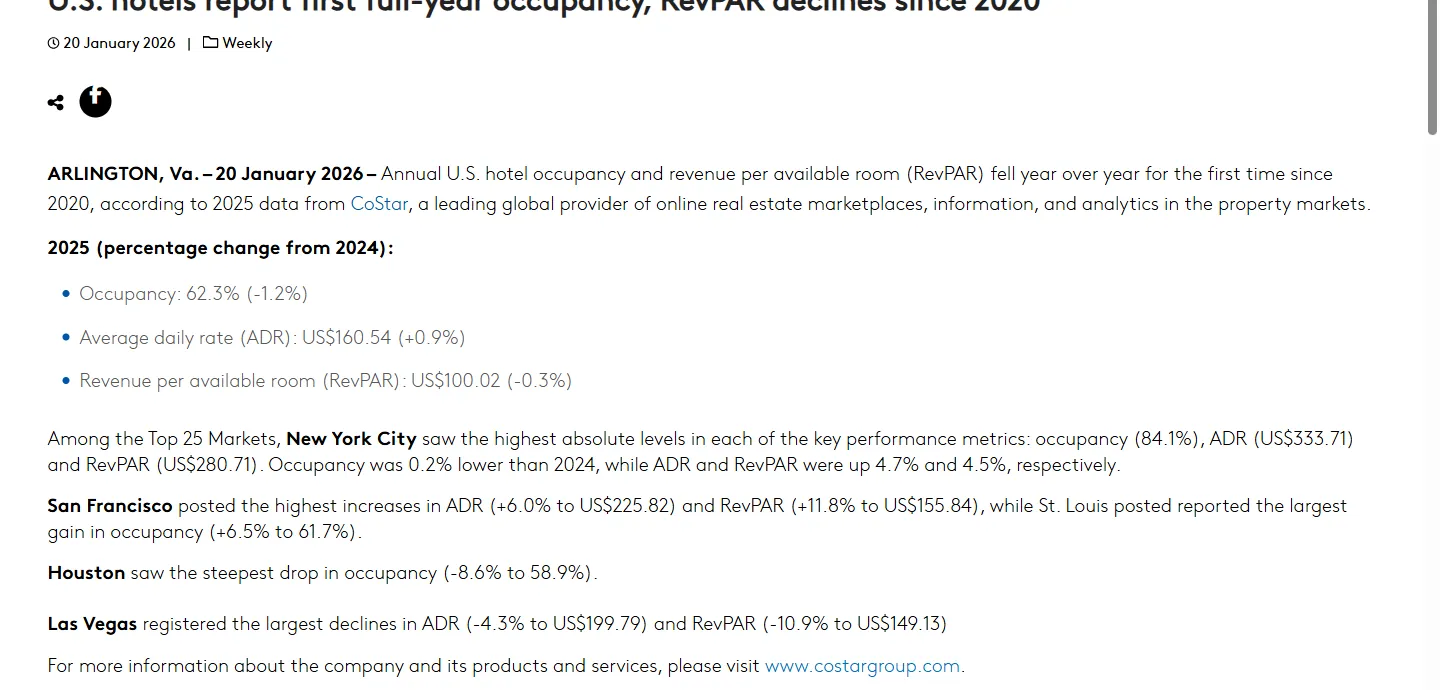
Markets moved in opposite directions. San Francisco posted the largest ADR gain among the top 25 markets in 2025, up 6.0% to $225.82, while Las Vegas recorded the largest ADR decline, down 4.3% to $199.79. In August 2026, San Francisco rose again, up 8.7% to $216.77, and New York City showed the largest ADR drop, down 3.3% to $275.07.
What is the average ADR of hotels in France?
French hotels averaged between €126.9 and €133 in 2025, depending on the panel. In Extenso reports a national average price of €133, up 1%, with occupancy at 64% and RevPAR at €85 (TourMaG, February 9, 2026). MKG data quoted by CBRE gives €126.9 excl. VAT, up 0.2%, with occupancy at 66.2%, up 0.8 points (CBRE Research, Figures Hôtels France T4 2025).
The two sources use different hotel samples. Neither is wrong, but you should pick one and benchmark yourself against it every year.
Behind the national figure, In Extenso describes a split market. Paris hotels had an average price of €239 in 2025, down 1%, but up 41% since 2019, with occupancy at a record 82%. Hotels in Ile-de-France outside Paris posted €105, down 8%. Economy and super-economy hotels in the largest urban areas of the French regions sat at €78, with occupancy at 64%. On the Côte d'Azur, the average price was €226, up 5%, with occupancy at 68%.
How does ADR change by hotel category?
ADR rises sharply with the category. MKG data processed by the Provence-Alpes-Côte d'Azur tourist board shows an average price of €65 for super-economy hotels in French urban areas in 2025, €90 for economy, €129 for midscale, €224 for upscale and €706 for luxury.
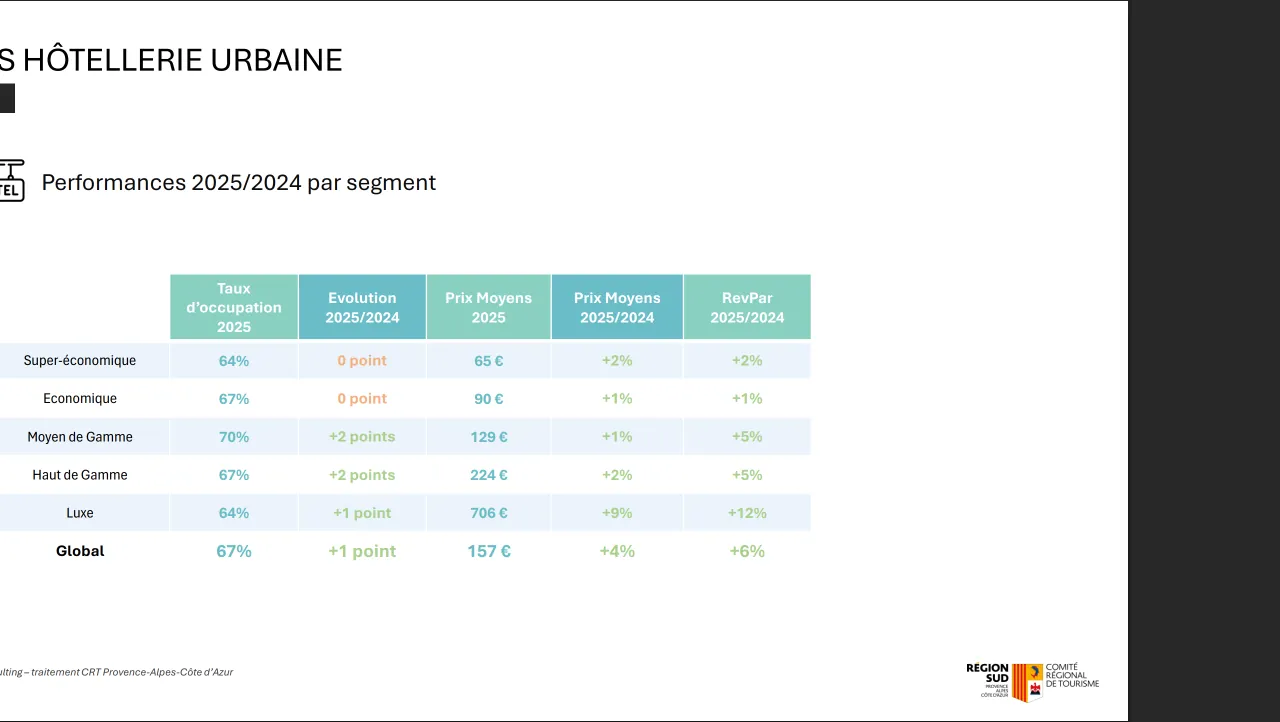
The same table gives an overall average of €157 for urban hotels, up 4%, with luxury up 9% and the other segments up 1% or 2%. Luxury charges about 10.9 times the price of super-economy (€706 ÷ €65, calculation from the MKG table). Occupancy runs the other way round, with midscale highest at 70% and luxury and super-economy both at 64%.
Do not compare this €157 with the €126.9 of the national MKG figure above. The CRT table covers urban hotels, while the national figure covers all hotels, including rural and seasonal ones. Source scopes are the first thing to check before you read any ADR benchmark.
Hilton shows the same ladder by brand
Hilton reports ADR for each of its brands, which gives a clean price ladder inside one company. In the third quarter of 2026, Waldorf Astoria posted an ADR of $472.06, Conrad $268.50, Hilton Hotels and Resorts $197.77, DoubleTree $153.40, Hampton $135.98 and Tru $135.10.
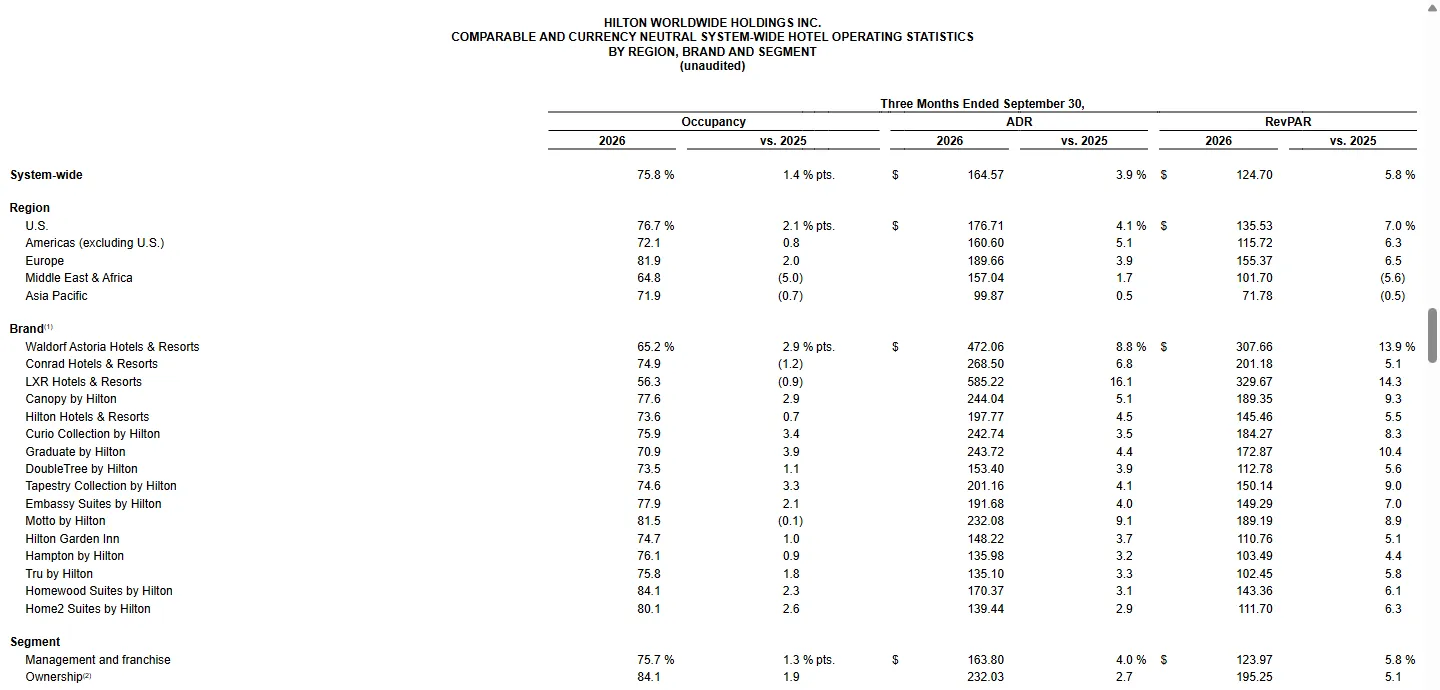
Waldorf Astoria's ADR is about 3.5 times that of Tru ($472.06 ÷ $135.10, calculation from the Hilton table). These are comparable, currency-neutral figures for Hilton's own hotels, so they describe one chain and not the market.
How does ADR change by region and city?
Location moves ADR as much as category does. Hilton's Europe hotels posted an ADR of $189.66 in the third quarter of 2026, up 3.9%, while its Asia Pacific hotels posted $99.87, up 0.5%, and its U.S. hotels $176.71, up 4.1%.
City figures swing with events. CoStar reported the following preliminary monthly results:
| City | Period | ADR | Change on the year | Occupancy |
|---|---|---|---|---|
| Paris | August 2026 | €342.97 | +8.7% | 75.0% |
| Milan | September 2026 | €310.04 | +7.2% | 84.2% |
| Monaco | June 2026 | €1,267.48 | +85.6% | 81.4% |
| Melbourne | September 2026 | AUD 242.11 | +16.2% | 75.6% |
Paris benefited from the Rock en Seine festival, Milan from the Italian Grand Prix and Fashion Week, Monaco from the Formula 1 Grand Prix and Melbourne from the AFL Grand Final. These are monthly peaks, so they do not compare with the 2025 annual averages above. The CoStar sources are the Paris, Milan, Monaco and Melbourne releases. In Monaco, the single night of June 6, 2026 reached an ADR of €3,944.81.
What ADR do online travel agencies report?
OTAs publish a platform average that mixes every property, so it cannot stand in for a hotel benchmark. Expedia Group reported an ADR booked of $220.6 for the second quarter of 2026, up 5% on the $209.3 of the second quarter of 2025, on 111.5 million booked room nights (Expedia Group, exhibit 99.1).
Booking Holdings reported 325 million room nights for the same quarter and said constant-currency accommodation ADRs rose about 2% (Booking Holdings, exhibit 99.1). Both figures include villas, apartments and hotels at every price point.
How can a hotel raise its ADR without losing occupancy?
Raise ADR by changing what you sell and where you sell it, not by lifting every rate. The levers below work on mix and timing. Check each one against RevPAR, because a higher ADR that costs you rooms sold is a loss.
- Price to demand. Move rates by day of the week, lead time and local events. The CoStar city figures above show how much one event week can add. Our hotel PMS comparison lists which systems include revenue management.
- Shift the mix to higher-rate rooms. Sell upgrades and room types in order of rate, and stop discounting the best rooms first.
- Shift the mix to direct. A booking on your own site often pays no commission, which raises what you keep even when ADR stays flat. A booking engine with rate and package options helps here.
- Keep rates consistent across channels. A channel manager pushes one rate to every OTA at once and avoids undercutting yourself.
- Set minimum stays on peak nights. A two-night minimum on a sold-out Saturday protects the high rate and fills the nights around it.
What should you do next?
Compute your own ADR for the last twelve months, by month and by channel, then compare it with the benchmark that matches your category and city. If your ADR index against your competitive set is below 100, check whether the gap comes from rate, from channel mix or from room types, before you change any price.
Frequently asked questions
What does ADR mean in a hotel?
ADR stands for average daily rate, the average room price a hotel earned per room sold. It equals rooms revenue divided by the number of rooms sold over the same period. Hilton defines it the same way in its quarterly results, as hotel room revenue divided by room nights sold.
What is the ADR formula?
Divide rooms revenue by rooms sold. A hotel that earns $9,600 from 80 rooms sold in a night has an ADR of $120. You can also rearrange the RevPAR formula, since ADR equals RevPAR divided by occupancy.
What is a good ADR for a hotel?
A good ADR is one that beats your competitive set without costing you occupancy. National averages are only a frame, for example $160.54 for US hotels in 2025 according to CoStar, or €133 for French hotels according to In Extenso. Segment, city and season move the figure far more than the national number.
What is the difference between ADR and RevPAR?
ADR averages the price of the rooms you sold. RevPAR spreads rooms revenue over every room you had available, sold or not, so it equals ADR multiplied by occupancy. A hotel can raise its ADR and still lose RevPAR if occupancy drops faster than the rate rises.
Does ADR include taxes, breakfast and commissions?
It depends on the rules you set, so write them down and keep them constant. Many hotels report ADR on room revenue net of VAT or sales tax and without food and beverage. Commissions are normally not deducted, which is why some revenue managers also track a net ADR.
Why is the ADR of OTAs different from a hotel's ADR?
Expedia Group reports ADR booked, which is total lodging gross bookings divided by booked room nights, across all its lodging. It was $220.6 in the second quarter of 2026. That is a platform average, so it says little about what a single hotel earns.
Sources
- CoStar, U.S. hotels report first full-year occupancy, RevPAR declines since 2020 (January 20, 2026)
- CoStar, U.S. hotel performance for August 2026 (September 28, 2026)
- CoStar, Rock en Seine boosted Paris hotel performance (September 15, 2026)
- CoStar, Milan hotel room rates approached all-time high thanks to Grand Prix and Fashion Week (October 14, 2026)
- CoStar, Grand Prix drove Monaco ADR and RevPAR to record highs (July 14, 2026)
- CoStar, AFL Grand Final pushed Melbourne hotel room rates to a September record (October 14, 2026)
- Hilton, Third Quarter 2026 Results, exhibit 99.1 (October 27, 2026)
- Expedia Group, Second Quarter 2026 Results, exhibit 99.1 (August 5, 2026)
- Booking Holdings, Second Quarter 2026 Results, exhibit 99.1 (August 4, 2026)
- CBRE Research, Figures Hôtels France T4 2025 (MKG data)
- TourMaG, In Extenso review of French hotel performance in 2025 (February 9, 2026)
- CRT Provence-Alpes-Côte d'Azur, Bilan 2025 de la fréquentation de l'hôtellerie régionale (MKG Consulting and Insee data)